
TWI Job Instruction: the four-step method for training that sticks.
TWI job instruction explained: where the four-step method came from, how to write a job breakdown sheet, and how to run your first session on Monday.
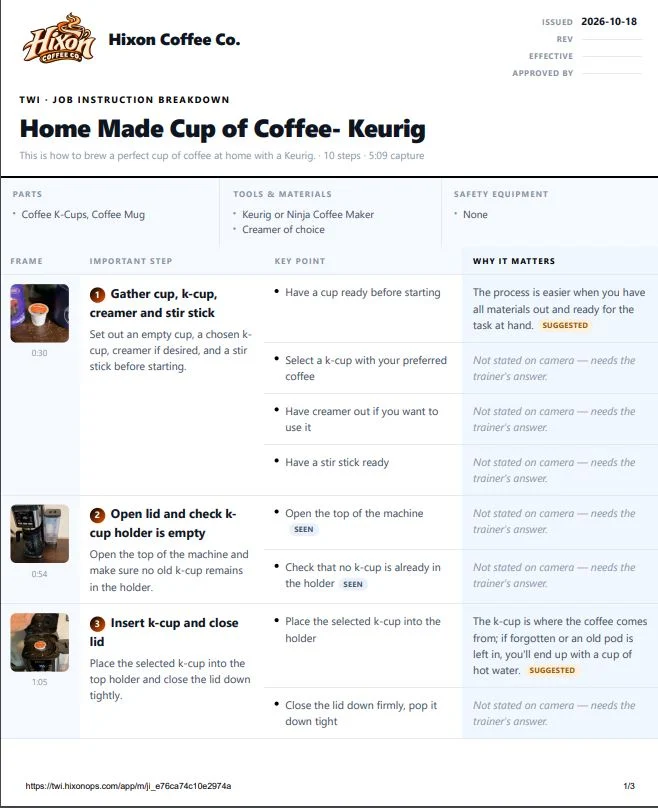
Most shops train the same way. A new hire shows up, you point at your best operator, and you say "follow Dave." Dave is good at the job. Dave is not good at teaching it, because nobody ever taught him how. Three weeks later the new hire does the job the way Dave does it on a bad day, minus the two things Dave forgot to mention. TWI Job Instruction is the fix for that, and it is older than most of the machines on your floor.
Where Job Instruction came from
Training Within Industry started in August 1940 inside the Council of National Defense and closed in the fall of 1945, at the same time the War Manpower Commission it had become part of stopped operating.[1] The problem they were handed was blunt: war plants needed more product from workers who had never been inside a factory.
The first real test was lens grinding. In the fall of 1940 the arsenals and navy yards put out a call for 350 qualified lens grinders and could not find them.[1] The trade assumed it took a learner about five years to master the work.[1] When TWI studied the job, it found that "lens grinder" was really 20 separate jobs, and that in each one a handful of critical points decided whether the work came out right.[1] The report calls those key points the cornerstone of the whole program.[1] Training for the separate lens-grinding jobs dropped from roughly five years to a matter of months.[1]
The teaching method itself was not new. Charles R. Allen had worked out a four-step pattern in the Emergency Fleet Corporation during the first World War: Preparation, Presentation, Application, and Inspection (or test).[1] He wrote it up in a 1919 book, The Instructor, the Man, and the Job, where he spent a lot of ink on the difference between teaching and telling.[1] In the spring of 1941 Glenn Gardiner told the New Jersey panel that Allen's four steps could be packaged into a standard program called "How to Instruct," and the group settled on five two-hour sessions, with the fire underwriters' knot as the demonstration job.[1] The program first ran in New Jersey in June 1941, and TWI headquarters adopted it nationally that August, folding in the steps-and-key-points job breakdown from the lens-grinding work.[1]
By the time the final report was written in September 1945, TWI had issued 1,005,170 Job Instruction certificates out of 1,750,650 total across its programs, in 16,511 plants and unions.[1] Every one of those certificates meant a supervisor had sat at a table in a group of ten for five two-hour sessions and practiced the method on a job from their own department.[1]
Then American industry mostly forgot about it. The Lean Enterprise Institute's lexicon puts it plainly: the concepts were forgotten in the U.S. amid post-war prosperity, while struggling Japanese companies, including Toyota, picked them up.[2]
The four steps
Job Instruction is a four-step method for teaching one person to do one job correctly, safely, and consistently.[2] Here is the "How to Instruct" side of the pocket card as LEI publishes it today.[3]
| Step | Name | What the card tells the instructor to do |
|---|---|---|
| 1 | Prepare the person | Put the person at ease. Describe the job and find out what they already know. Get them interested. Place them in the correct position. |
| 2 | Present the operation | Tell, show, and illustrate one important step at a time. Stress each key point and reason. Do not give more than the person can master at one time. |
| 3 | Try out performance | Have the person do the job and correct errors. Have them explain each important step, key point, and reason as they do it again. Continue until you know they know. |
| 4 | Follow up | Put the person on their own. Designate who they go to for help. Check frequently and encourage questions. Taper off the extra coaching. |
Two things on that card deserve attention.
First, notice how much of step 3 is the learner talking. That was a wartime correction. The 1945 report says TWI found that workers often copied motions without understanding them, so it was no longer enough for the learner to do the job in step 3; they had to tell the instructor what they were doing and why.[1] Watching someone do the job once is not proof they learned it. Hearing them explain the key points while they do it is.
Second, the last line on the card: "If the Person Hasn't Learned, the Instructor Hasn't Taught."[3] That puts the result on the trainer, not the trainee. It is the opposite of "follow Dave."
NIST's MEP program describes the same four steps as preparation, presentation, test (trial runs), and follow up, with coaching that tapers off until the employee works alone.[4] Different words, same card.
Getting ready to instruct
The other side of the card is the part most shops skip. Before you teach, the card says to have a timetable (which skills you expect each person to have by what date), break down the job, have the right equipment, materials, and supplies ready, and arrange the workplace the way the worker will be expected to keep it.[3] If you have ever trained someone on a bench with the wrong gauge, you know why.
The job breakdown sheet
The breakdown is where TWI earns its keep. It is the instructor's notes: one sheet, three columns.[2]
| Column | Question it answers | Definition on the sheet |
|---|---|---|
| Important steps | What? | A logical segment of the operation when something happens to advance the work.[5] |
| Key points | How? | Anything in a step that might make or break the job, injure the worker, or make the work easier.[5] |
| Reasons | Why? | The reasons for the key points.[5] |
Those definitions are not modern additions. The 1945 report prints a sample breakdown sheet for an in-feed grind on a centerless grinder with the same step and key-point definitions, and the step reads "Place piece on plate against regulating wheel" with the key point "don't catch on wheel."[1] When TWI found that breakdowns were the weakest part of the 10-hour programs, it drilled trainers on three questions for finding key points: "Is there anything in the step that will make or break the job? Hurt the worker? Or make the operation easier to do?"[1]
One difference between then and now: the wartime card said to list the important steps and pick out the key points, and that safety is always a key point.[1] The card LEI publishes today adds reasons alongside the key points.[3] That third column matters more than it looks. A key point without a reason is a rule. A key point with a reason is knowledge, and people keep knowledge longer than rules.
What a good breakdown looks like
A breakdown is not a work instruction. It does not list every motion. The report's own 1944 revision shows the direction: an early manual described the first step of the knot in two long sentences about which hand and which finger; the later manual cut it to "Untwist and straighten ends. Hold in left hand at point 'C'."[1] The step is short. The key points carry the detail.
Graupp and Wrona's The TWI Workbook (Productivity Press, 2016, second edition) spends whole sections on what counts as an important step, what counts as a key point, how to list the reasons, how to make a balanced breakdown, and how to observe and involve experienced workers in the breakdown process.[6] That last item is the practical one. The person who writes the breakdown should be standing next to Dave, watching him do the job, and asking why he does that thing with his thumb.
Here is a plain illustration of the layout for a job most fab shops have, deburring a laser-cut stainless part. It is not a standard for your shop; your key points will be different.
| Important step | Key points | Reasons |
|---|---|---|
| Pick up the part by the flange | Gloves on. Check both faces for slag | Edges are sharp. Slag on the show face means a reject later |
| Deburr the outer edge | Light pressure, wheel moving away from you. One pass | Heavy pressure rounds the edge past the drawing. A second pass heats and discolors stainless |
| Check the edge | Fingernail test along the full edge | A burr you can catch with a nail will scratch the next operator and the customer |
| Set on the rack, show face up | Face up, no stacking | Stacked parts scratch each other |
Four steps. Maybe ten key points. Every reason is one sentence. That is the sheet.
How Toyota adopted it
The clearest account of Toyota and TWI comes from Isao Kato, who spent 35 years at Toyota and is known inside the company as the father of its standardized work and kaizen courses.[7] In a 2006 interview with Art Smalley, Kato said TWI came to Japan around 1947 or 1948 and was used at other companies first.[7] Toyota adopted it after the labor agreements of 1950, when management agreed to the union's request for some form of supervisor training, and HR went looking for an existing program.[7]
Job Instruction came first, in December 1951, then Job Methods in June 1952, then Job Relations in March 1953, with about 300 people trained in each.[7] Job Methods was eventually dropped; Kato says Taiichi Ohno found it too shallow for the kind of improvement he wanted.[7] Job Instruction was the opposite. Ohno himself was a trainer of the material, and Kato says JI "remains in Toyota today in a virtually unchanged fashion from the original."[7]
Kato credits JI with three things: a way to break down a job, a four-step method for training others, and a multi-functional skills planning matrix.[7] He argues that companies struggle with standardized work because nobody planned how to train people to the new method, and that JI is the skill set for exactly that work.[7] LEI says the same thing from the other direction: Job Instruction is still the primary training tool used by Toyota's team leaders worldwide.[2]
Liker and Meier's Toyota Talent (McGraw-Hill, 2007) is the book-length version. Its second section is titled "The Job Instruction Method," and it puts a chapter called "Standardized Work as the Foundation for Training" right before it.[8] Dinero's Training Within Industry: The Foundation of Lean (Productivity Press, 2005), which won a Shingo Prize, makes the same case from the history side: standardized work sets a baseline, and TWI is how you get there.[9]
The skills matrix Kato mentions is the piece that connects JI to your weekly schedule. If you have not built one yet, start with Building a skills matrix for a manufacturing team. The matrix tells you who to train next. JI tells you how.
Why it matters for a 40-person shop
You do not need Toyota's problems to need Job Instruction. You need one of these: turnover, a retirement coming, a second shift you cannot staff, or a quality escape that traces back to "I didn't know I was supposed to do that."
The MEP network treats TWI as a standard offering. NIST MEP calls it a component of a lean and continuous improvement approach and says companies that implement it have seen the time to develop new hires into productive workers cut in half, along with reductions in scrap and rework.[4] That is NIST's statement, not a study I can show you, so weigh it as such. Purdue MEP describes the objective of JI as less scrap and rework, fewer accidents, and less tool and equipment damage.[10] A South Carolina MEP case from 2020 is a familiar story: a packaging plant added about 90 people in a year, onboarding buckled, productivity and quality per person dropped, and the center's answer was 10-hour JI and Job Relations modules for groups of up to ten.[11] Texas's TMAC runs a 10-hour JI module inside its supervisor certification,[12] and Tennessee's MEP describes the goal of JI as a culture where every worker can become a skilled instructor.[13]
The TWI Institute, which carries the original program forward, runs JI the way it was run in 1941: 10 hours, up to 10 participants, and you bring a sample job from your own floor.[14] One of its stated objectives is to eliminate job shadowing and "buddy" training by creating shop-floor skills trainers.[14] Dave is a buddy. You want Dave to be a trainer.
Here is what I saw in 15 years of stainless steel manufacturing, from the drafting table into continuous improvement. Every shop had good people and the knowledge to run every job. What it did not have was that knowledge written down in a form you could teach from. The breakdown sheet gets it onto paper without turning it into a 14-page work instruction nobody reads.
Run your first JI session on Monday
You do not need a certified trainer to start. You need one job, one experienced operator, one learner, and about two hours.
- Pick a small job. One operation, 10 minutes or less, that a new person has to learn in their first month. Not the hardest job. The one you train most often.
- Write the breakdown with the operator, at the machine. Three columns: important steps (what), key points (how), reasons (why). Ask the three questions for every step: what could make or break it, what could hurt someone, what makes it easier. Keep steps short. Put the detail in the key points.
- Set the timetable. Write down who learns this job and by what date. One line is enough.
- Get everything ready. Parts, tools, gauges, the right fixture, and the workplace arranged the way you want it kept.
- Teach it in four steps. Prepare: put them at ease, find out what they know, position them correctly. Present: one important step at a time, key points and reasons, no more than they can hold. Try out: they do it, you fix errors, then they do it again while explaining each step, key point, and reason. Follow up: tell them who to ask, check in that afternoon and the next morning, and taper off.
- Check your own work. If they could not explain a key point, the breakdown is missing something or you went too fast. Fix the sheet, not the learner.
- File the sheet. Date it, name the operator who helped write it, and put it where the next trainer can find it.
Do that once and you will see what was missing from "follow Dave." Do it ten times and you have a training system.
Two tools, briefly
If you would rather not start from a blank sheet, HixonOps offers a free TWI breakdown tool at twi.hixonops.com: film the job, and it drafts the breakdown sheet for you to correct with the operator. Our talent system has Job Instruction built in, so the breakdowns, the timetable, and the skills matrix live in the same place and the follow-up step does not get lost.
Neither is required. A sheet of paper and the four steps worked in 16,511 plants in 1945.[1] They will work in yours.
Sources
- War Manpower Commission, Bureau of Training, Training Within Industry Service. The Training Within Industry Report, 1940-1945. U.S. Government Printing Office (via GovInfo). 1945. https://www.govinfo.gov/content/pkg/GOVPUB-PR32_5200-00275cf1fd80a1d51995ae716fd38f34/html/GOVPUB-PR32_5200-00275cf1fd80a1d51995ae716fd38f34.htm Accessed 2026-10-18. ↩
- Lean Enterprise Institute. Training Within Industry (TWI) | Lean Lexicon. lean.org. https://www.lean.org/lexicon-terms/training-within-industry-twi/ Accessed 2026-10-18. ↩
- Lean Enterprise Institute. TWI Job Instruction Card (How to Get Ready to Instruct / How to Instruct). lean.org. 2006. https://www.lean.org/wp-content/uploads/2021/01/TWI-Job-Instruction-Card.pdf Accessed 2026-10-18. ↩
- NIST Manufacturing Extension Partnership. Training Within Industry (TWI). nist.gov. 2024. https://www.nist.gov/mep/training-within-industry-twi Accessed 2026-10-18. ↩
- Lean Enterprise Institute. TWI training cards for printing (includes Job Breakdown Sheet). lean.org. https://email.lean.org/hubfs/ebook%20files/TWI_training_cards_for_printing.pdf Accessed 2026-10-18. ↩
- Patrick Graupp and Robert J. Wrona. The TWI Workbook: Essential Skills for Supervisors, Second Edition. Productivity Press (Routledge catalog page). 2016. https://www.routledge.com/The-TWI-Workbook-Essential-Skills-for-Supervisors-Second-Edition/Graupp-Wrona/p/book/9781498703963 Accessed 2026-10-18. ↩
- Art Smalley (interview with Isao Kato). Summary Notes from Art Smalley Interview with Mr. Isao Kato: TWI Influence on TPS & Kaizen. Art of Lean, hosted by lean.org. 2006. https://www.lean.org/Search/Documents/380.pdf Accessed 2026-10-18. ↩
- Jeffrey K. Liker and David Meier. Toyota Talent: Developing Your People the Toyota Way. McGraw-Hill (publisher catalog page). 2007. https://www.mheducation.com/highered/mhp/product/toyota-talent.html Accessed 2026-10-18. ↩
- Donald A. Dinero. Training Within Industry: The Foundation of Lean. Productivity Press (Routledge catalog page). 2005. https://www.routledge.com/Training-Within-Industry-The-Foundation-of-Lean/Dinero/p/book/9781563273070 Accessed 2026-10-18. ↩
- Purdue Manufacturing Extension Partnership. Training Within Industry (TWI) by Purdue MEP. mep.purdue.edu. 2024. https://mep.purdue.edu/services/training-within-industry Accessed 2026-10-18. ↩
- South Carolina Manufacturing Extension Partnership (SCMEP) / NIST MEP. Constantia Flexibles Makes New Investments and Increases Jobs Following SCMEP's Training Within Industry Program. NIST MEP success story (ws680.nist.gov). https://ws680.nist.gov/mepmeis/ss.ashx?SSID=5830 Accessed 2026-10-18. ↩
- TMAC (Texas Manufacturing Assistance Center) at Southwest Research Institute. Manufacturing Supervisor Certification (course brochure). swri.org. 2024. https://swri.org/sites/default/files/2024-01/manufacturing-supervisor-certification.pdf Accessed 2026-10-18. ↩
- Tennessee Manufacturing Extension Partnership (UT Center for Industrial Services). Training Within Industry Job Instruction (program sheet). tmep.cis.tennessee.edu. 2023. https://tmep.cis.tennessee.edu/sites/default/files/2023-12/TWI%20Job%20Instruction.pdf Accessed 2026-10-18. ↩
- TWI Institute. Job Instruction (JI). twi-institute.com. https://www.twi-institute.com/job-instruction/ Accessed 2026-10-18. ↩
Related posts
Building a skills matrix for a manufacturing team.
How to build a skills matrix for a manufacturing team: four levels, finding single points of failure, and a 30-minute method to fill it in on Monday.
Read the post →You don't need a new ERP. You need to see your floor.
An ERP alternative for manufacturing that keeps your ERP: what ERP does well, what the floor needs, the ISA-95 levels, real ERP risk, and a Monday test.
Read the post →